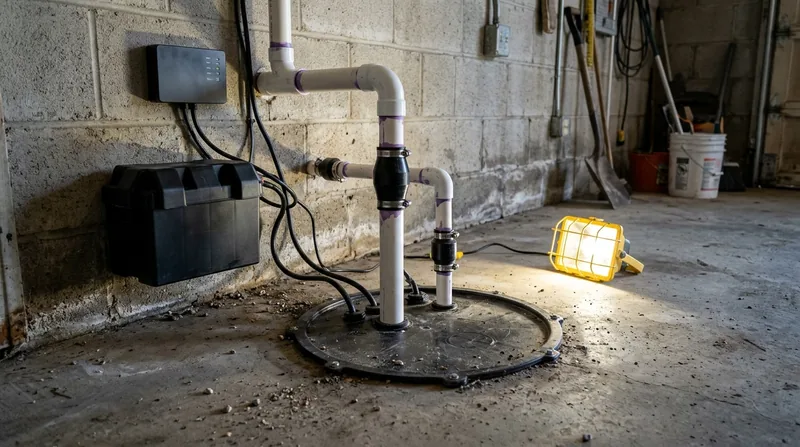




A Battery Backup Sump Pumps in Jacksonville setup is the difference between a dry slab edge and a flooded garage when the grid goes down mid-storm. Onslow County sits on sandy coastal plain soil over a water table that is only a few feet down, so water rises fast after a summer thunderstorm or a tropical system like Florence in 2018. Most homes here are 1960s to 1990s brick and vinyl ranches off Western Boulevard and Richlands Highway, plus 2000s to 2020s subdivisions off Piney Green Road and Gum Branch Road, and nearly all sit on concrete slabs with sump pits set in garages and utility rooms. When the power drops, the primary pump stops and the pit fills in minutes. A battery backup keeps the pump running on DC power, sounds an alarm, and holds the line until the utility comes back. Call (910) 915-4979 to size one to your pit, or start with a free basement inspection.
Why Battery Backup Sump Pumps Matter in Jacksonville's Storm Season
The failure mode that dominates here is not a slow seep. It is a fast rise. Sandy soil drains quickly until it saturates, then the water table pushes against the slab edge and the pit fills within minutes of a heavy band. Clay pockets along the creek bottoms hold water even longer. The worst case is a hurricane or summer squall that knocks out power at the same moment the pit is working hardest, which is exactly when a primary pump has no backup.
- Power outages during tropical systems and summer thunderstorms stop the primary pump with the pit already full.
- Sandy soil over a shallow water table sends water to the pit faster than a single AC pump can clear it.
- Clay pockets near creek bottoms hold water against the slab edge for days after the rain stops.
- Older ranches off Western Boulevard often have undersized pits that fill before a backup can cycle.
A backup pump does not replace the primary. It covers the gap when the primary loses power or fails, and it buys time until you can get a replacement in.
Key info: After Florence in 2018, homes off Gum Branch Road and Piney Green Road sat without power for days while the water table stayed high. A battery backup with a float alarm is what kept those pits from overflowing into the garage.
Permits and code questions for drainage work run through the local building department, and rules vary by jurisdiction, so verify before any work alters a discharge connection. The City of Jacksonville is the place to start.
How We Size and Install a Battery Backup in Jacksonville
We start at the pit, not the catalog. The backup has to match your basin volume, the head height of the discharge line, and how fast water actually enters during a storm. A unit sized for a trickle will not keep up with a saturated slab edge. We check the check valve, the discharge line routing, and the float switch before we quote anything, because a backup on a clogged line just burns through battery.
- We inspect the pit, the primary pump, the check valve, and the discharge line to confirm the backup will actually move water.
- We measure basin volume and head height so the backup pump matches your pit and your storm load.
- We mount the battery and charger in a dry spot, wire the float switch, and test the alarm.
- We run a full cycle with the primary off to confirm the backup carries the pit on its own.
- We walk you through the alarm, the battery check, and the maintenance interval before we leave.
If the primary pump is already tired, we will tell you plainly that a sump pump installation or replacement is the better spend than a backup on a failing unit.
Key info: On a ranch off Richlands Highway, the pit was filling in under four minutes during a summer storm. The primary pump was fine, but the discharge line was partially clogged. We cleared the line, sized a backup to the real inflow, and the pit has held through every storm since.
Backup Pump Options We Install
Not every pit needs the same hardware. We match the unit to the pit, the storm load, and how much run time you want after the power drops. The table below shows the approaches we use most in Jacksonville.
| Approach | Description | Best for |
|---|---|---|
| DC battery backup pump | A 12V DC pump and charger wired to the existing pit, with a float switch and alarm. | Standard slab-edge pits in 1960s to 1990s ranches. |
| Combination primary and backup | A matched AC primary and DC backup on one discharge line with a shared check valve. | Older pits where the primary is due for replacement. |
| High-capacity battery bank | Larger battery capacity for longer run time during extended outages. | Homes that lost power for days after a tropical system. |
| Alarm and monitoring add-on | High-water float alarm and battery status indicator on the pit. | Homeowners who want warning before the pit tops out. |
We will tell you when a simple backup is enough and when the real problem is hydrostatic pressure that needs an interior drain tile system feeding the pit.
Battery Backup Sump Pumps Cost in Jacksonville: What to Expect
Most battery backup installs in Jacksonville start around $900 for a standard DC unit on an existing pit with a working primary. That figure covers the pump, battery, charger, float switch, and a full test cycle. It moves up when the pit needs work, the discharge line needs rerouting, or you want a high-capacity battery bank for extended outages.
The factors that move the number are the pit size, the head height on the discharge line, whether the primary pump needs replacement at the same time, and the battery capacity you choose. A combination primary and backup on an older pit off Western Boulevard costs more than a backup added to a newer pit off Piney Green Road, because the older pit usually needs a new check valve and a discharge line check.
Get two or three estimates and ask each one what pump model, what battery capacity, and what test they run before they leave. A quote that does not name the unit is not a quote. Our full pricing overview lays out the ranges.
Battery Backup Sump Pumps Near Me: How to Vet a Jacksonville Contractor
You want a specialist who works below grade every week, not a general handyman who has installed one backup pump. Ask for the license and insurance certificate before work starts, and confirm the quote names the pump model, the battery capacity, and the test cycle. Ask for two local references from pits similar to yours, and ask whether the discharge connection needs a permit from the local building department.
HOA rules in the newer subdivisions off Gum Branch Road can restrict where the discharge line terminates, so check before the install day. A contractor who has worked those neighborhoods will already know the common restrictions. Reach out through our contact page to schedule an estimate.
Battery Backup Sump Pumps in Jacksonville: Pricing Guide
| Service | Price | Details |
|---|---|---|
| Standard DC battery backup install | Starting at $900 | Includes pump, battery, charger, float switch, and full test cycle on an existing pit. |
| Combination primary and backup | Starting at $1,400 | Adds a matched AC primary pump and shared check valve when the existing primary is due. |
| High-capacity battery bank | On estimate | Larger battery capacity for extended outages; priced after we confirm pit volume and run-time target. |
| Alarm and monitoring add-on | Starting at $150 | High-water float alarm and battery status indicator wired to the pit. |
| Travel | Included | In Jacksonville and surrounding areas, no separate call-out or mileage fee. |
| Estimate | Free | Response within 24h at (910) 915-4979, no obligation to book. |
Indicative pricing, the exact cost depends on square footage, finish, and site access. Free personalized estimate within 24h at (910) 915-4979.


